
The Bottleneck You Can't Code Your Way Out Of

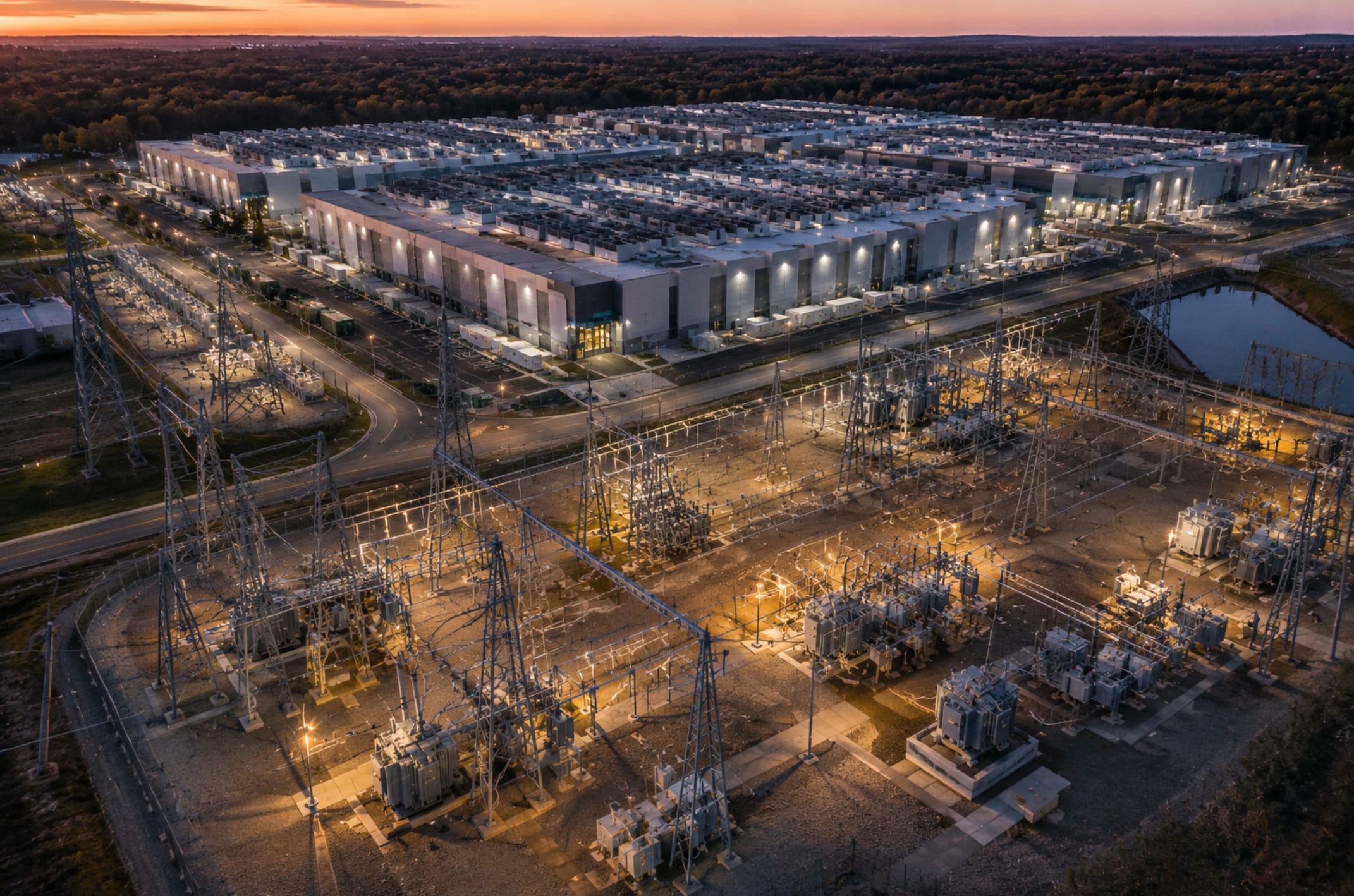
The AI economy runs on two clocks, and almost no one is watching the second one.
The first clock is digital. A chip design iterates in months, a software patch ships in minutes, and a data hall goes from groundbreak to first power-on in twelve to eighteen months. That’s the clock the industry built itself around - and the one that still dominates the coverage: quarterly GPU allocation reports, Nvidia’s next architecture, which lab ships the next frontier model.
The second clock is industrial. A large power transformer is bespoke, hand-wound, and weighs hundreds of tons. It is not a product you order and receive. It is a project. Standard units now carry lead times averaging 128 weeks. High-capacity, high-voltage orders routinely back up three to four years. You can have the capital, the land, the permits, and the GPUs, and still be unable to turn the lights on.
Those two clocks don’t synchronize. That mismatch is the actual story of 2026.
— — —
The consensus read on AI constraints is still stuck on compute —chip supply, GPU hoarding, Nvidia’s production capacity. That framing made sense through 2023 and into 2024; H100 allocations were genuinely the binding constraint. If you couldn’t get chips, you couldn’t train.
That constraint hasn’t disappeared. But the scarcity migrated.
Gartner projects that 40% of AI data centers will be strictly power-constrained by 2027, and developers are already reporting that up to half of planned builds face significant grid-interconnection stalls before a single shovel hits the ground. Not stalled in construction, but rozen before construction begins. The projects that need only twelve to eighteen months to complete are sitting announced, unbuilt, because grid connection cannot be secured.
A single large AI data center now draws between 100 megawatts and 1 gigawatt of electricity - up to ten times the power density of a traditional cloud facility. Demand for high-capacity transformers increased 274% between 2019 and 2025. You cannot close a gap like that by building a new factory. You can’t train certified high-voltage electricians in a quarter. The slow clock doesn’t care about urgency.
— — —
The most sophisticated operators have already internalized this, and their response doesn’t look like technology strategy. It looks like utility finance.
In January 2026, Meta finalized agreements with Vistra, Oklo, and TerraPower for up to 6.6 gigawatts of nuclear power by 2035. The structure matters as much as the scale. Meta isn’t buying plants. It’s signing 20-year power purchase agreements that serve as the financial anchor for projects that otherwise couldn’t raise capital. The hyperscaler’s offtake commitment de-risks the project for lenders. The balance sheet doesn’t just buy power; it creates power that would not otherwise exist. AWS is doing a version of the same with Vistra’s Comanche Peak plant in Texas. The pattern is consistent across the sector: tech balance sheets as de-risking instruments, long-term commitments as the mechanism by which new grid capacity gets financed at all.
The terminology among people paying close attention has already shifted. BYOP - bring your own power. Operators that can’t wait for utility interconnection queues are moving to on-site generation entirely, removing themselves from a queue that, in primary markets, now stretches years out. A two-tier real estate market has formed: grid-served sites that compete on cost, and nuclear-adjacent or behind-the-meter sites that compete on certainty. Certainty is commanding a 15 to 25 percent lease premium. That spread will widen.
— — —
Every technology cycle produces a new gate. Railroads created rail hubs. The internet created search engines and then app stores. Cloud computing consolidated into a handful of hyperscaler billing relationships. In each of those cycles, the gate was something Silicon Valley could build, buy, or code its way into controlling.
Not this time.
For the first time in decades, Silicon Valley does not control the bottleneck.
A utility executive in Virginia may have more influence over AI deployment timelines than many AI founders.
The most consequential manufacturing capacity in the AI economy right now doesn’t make chips. It makes transformers. The companies controlling that production (Hitachi Energy, Siemens Energy, GE Vernova) hold a form of leverage the technology industry hasn’t had to reckon with. Grain-oriented electrical steel, the specialized magnetic material at the core of every high-voltage transformer, has seen prices surge 75% from pre-pandemic baselines. The supply chain is structurally constrained in ways capital cannot quickly fix. You cannot build a new GOES facility the way you build a new data center. The timelines are a different order of magnitude.
The most important queue in the technology industry may no longer be a waiting list for GPUs. It may be a waiting list for electricity.
— — —
Value always migrates to the point of highest scarcity. Phase one of the AI economy was the scarcity of the algorithm. Phase two was the scarcity of compute. Phase three (the one we’re in) is the scarcity of physical infrastructure and electron delivery. The bottleneck is no longer digital. It is industrial.
For two decades, the technology industry won by operating on the faster clock. AI is forcing it to compete on the slower one. The next winners won’t simply build better models. They’ll be the ones who secured the infrastructure - the land, the power contracts, the transformer delivery slots - that allows those models to exist at all.
Stop looking at who has the best model. Look at who has the power contract, the land, and a confirmed transformer delivery in 2028. That’s the map of who captures the next phase of this.
Greg Kahn writes Beyond the Hype Cycle at the intersection of AI, media, and sports. He is the founder of GK Digital Ventures, AI Trailblazers, and The Global Game HQ